




There is a moment in every true journey when the world ceases to be a map and becomes a melody. It’s when the scent of street food mingles with ancient incense, when a foreign language becomes a rhythmic hum, and when the landscape before you is so profound it silences all thought. This is the essence of travel—not just seeing new places, but feeling them with every fiber of your being. It’s an immersion, a reawakening of the senses. Our journey today takes us to two corners of the globe that are masters of this sensory symphony: the emerald, mystical landscapes of Vietnam and the vibrant, spice-scented soul of Morocco. They are worlds apart, yet both offer a powerful invitation to lose yourself in order to find something new.

Part I: Vietnam – The Embrace of the Emerald Dragon
Vietnam is a country of breathtaking paradoxes. It is a land shaped by a tumultuous history yet defined by the graceful resilience of its people. It is where serene, timeless nature collides with the chaotic, exhilarating energy of modern life. My journey began in the north, in the heart of it all.
Hanoi’s Rhythmic Chaos
The first thing that strikes you in Hanoi’s Old Quarter is the sound. It’s a constant, flowing river of scooter horns, a percussive backdrop to the city’s life. It’s the sizzle of oil in a street vendor’s wok, the chatter from tiny plastic stools spilling onto the pavement, and the gentle ring of a bicycle bell. To walk here is to surrender to the current. I learned to cross the street not by waiting for a gap, but by moving slowly and steadily, allowing the river of traffic to flow around me. The air is thick with the aroma of Vietnam’s soul food: the rich, star-anise-infused steam rising from a bowl of phở, the smoky char of bún chả, and the comforting scent of freshly baked baguettes for a bánh mì. Amidst this beautiful chaos, I found tranquility by Hoan Kiem Lake, watching locals practice Tai Chi at dawn, a slow-motion ballet against the city’s frantic pace. It was a lesson in finding peace within the storm.
Ha Long Bay’s Ethereal Silence
Leaving the city behind, I journeyed to Ha Long Bay, a place that feels like a dream made real. Over 1,600 limestone karsts and islets, sculpted by millennia of wind and water, rise like ancient sea dragons from the Gulf of Tonkin’s emerald waters. Boarding a traditional wooden junk boat, the world transformed. The engine’s hum gave way to a profound silence, broken only by the gentle lapping of water against the hull and the cry of a distant eagle. We sailed through mist-shrouded grottoes and past floating fishing villages, where life moves to a different rhythm. At dusk, the sky bled into hues of orange and purple, silhouetting the karsts against the horizon. I tasted the freshest seafood imaginable, caught that day and cooked on our boat, its simple flavor a testament to the purity of the bay. The feeling was one of utter insignificance and complete connection—a tiny human speck in a landscape of geologic poetry.
Hoi An’s Lantern-Lit Magic
Hoi An is where Vietnam’s history whispers from every corner. This ancient port town is a perfectly preserved tapestry of Japanese merchant houses, Chinese temples, and French-colonial buildings. By day, its mustard-yellow walls are a photographer’s delight. But by night, Hoi An transforms into a fairytale. The old town becomes pedestrian-only, and thousands of colorful silk lanterns ignite, casting a warm, flickering glow on the streets and reflecting like jewels in the Thu Bon River. I spent an evening drifting in a small sampan boat, placing a paper lantern on the water and watching it join a constellation of wishes floating towards the sea. The taste of Hoi An is unique, from the chewy texture of its signature Cao Lầu noodles, made with water from a specific local well, to the delicate sweetness of white rose dumplings. It’s a city that feels suspended in time, a magical reprieve from the modern world.
Part II: Morocco – A Tapestry of Spice and Color
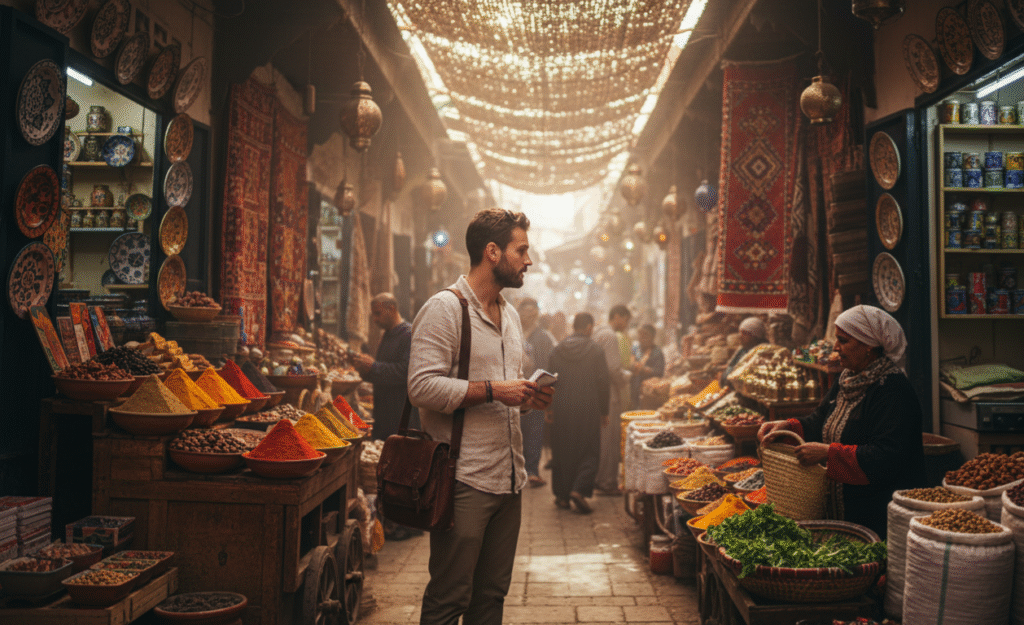
From the lush humidity of Southeast Asia, my journey took me to the arid, dramatic landscapes of North Africa. Morocco is a sensory overload in the most magnificent way. It’s a kingdom of intricate mosaics, towering minarets, and markets that pulse with a life unchanged for centuries.
Marrakech’s Djemaa el-Fna Heartbeat
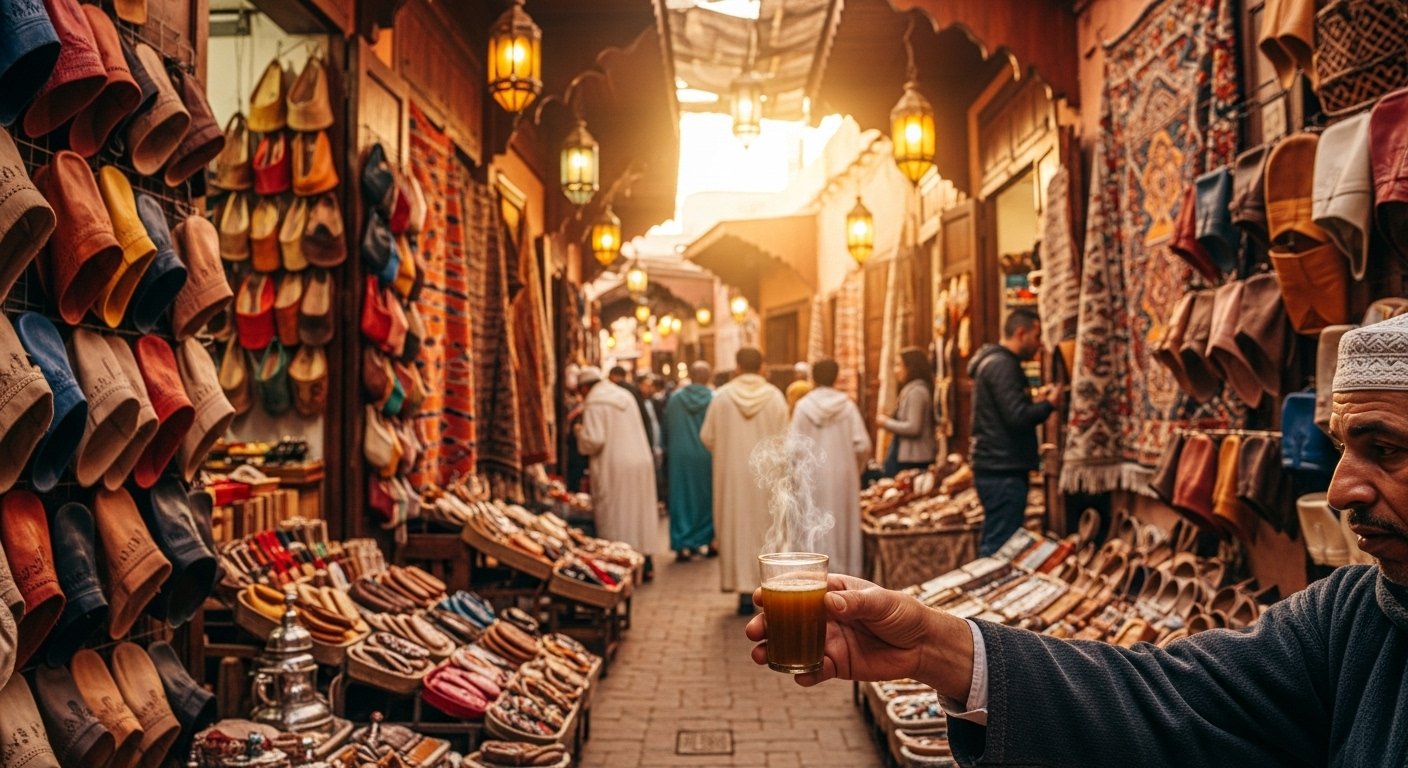
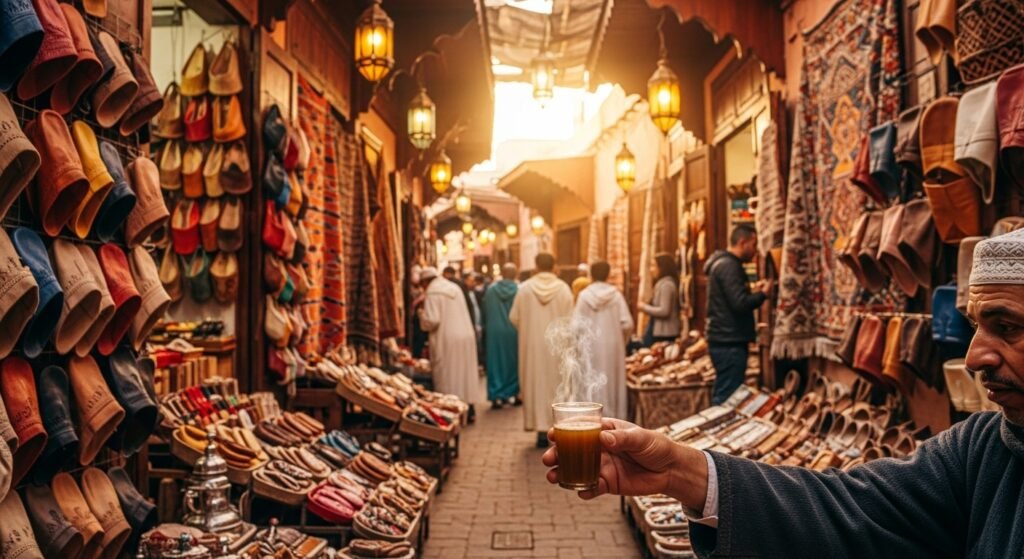
At the center of Marrakech’s labyrinthine medina lies Djemaa el-Fna, the city’s electric, beating heart. During the day, it’s a bustling square with snake charmers, henna artists, and fresh orange juice vendors. But as the sun sets, it undergoes a spectacular metamorphosis. The square erupts into a massive open-air theater and restaurant. Storytellers captivate crowds, Gnaoua musicians create hypnotic rhythms, and the air fills with a thick, tantalizing smoke from dozens of food stalls. The smell is a heady mix of grilled meats, cumin, saffron, and sweet mint tea. I navigated the throng, my senses on high alert, tasting a succulent lamb tagine cooked in an earthenware pot and feeling the vibrant energy of the crowd. Djemaa el-Fna is not a place you simply observe; it’s an immersive performance you become a part of.
The Sahara’s Infinite Horizon
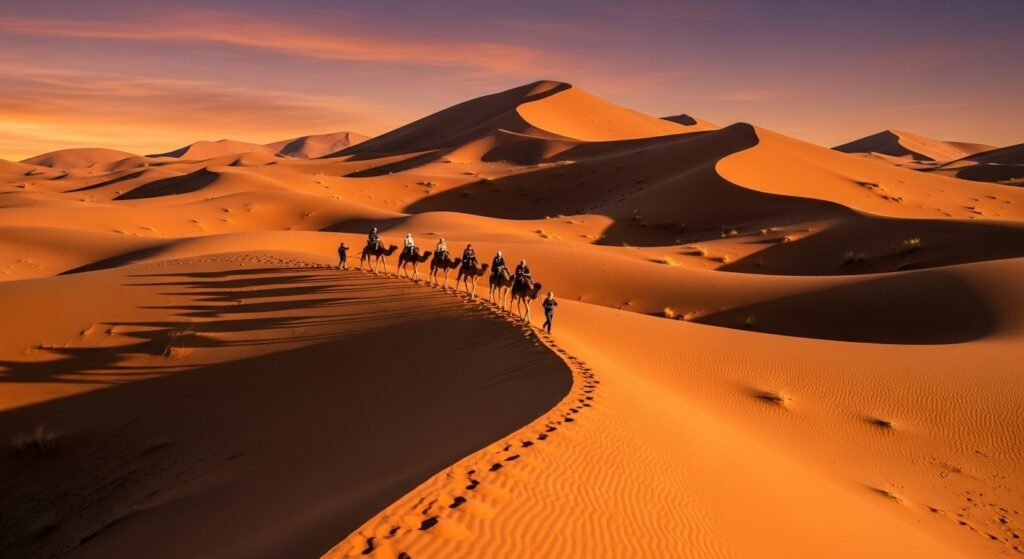
The journey from Marrakech to the Sahara Desert is a transition from complexity to sublime simplicity. Winding through the High Atlas Mountains, the landscape shifts from green valleys to stark, rocky plains, finally giving way to an ocean of sand: the Erg Chebbi dunes. The camel trek into the desert at sunset was a meditative experience. The only sound was the soft plod of the camels’ feet on the sand and the whisper of the wind. The dunes, rising hundreds of feet, were waves of liquid gold, their colors shifting with the dying light. That night, at a Berber camp, we ate under a celestial blanket of stars so bright and numerous they felt within arm’s reach. The silence of the desert is absolute, a profound emptiness that fills your soul. Waking before dawn to climb a dune and watch the sunrise—a slow, silent explosion of color over the endless horizon—was a moment of pure, unadulterated awe.
Fes’s Medieval Maze
If Marrakech is the heart of Morocco, Fes is its soul. The Fes el-Bali medina is one of the world’s largest living medieval cities, a bewildering labyrinth of over 9,000 alleys, many too narrow for anything but pedestrians and donkeys. Getting lost here is not a possibility; it’s a guarantee, and the true point of the experience. Every wrong turn reveals a new wonder: a hidden courtyard with intricate zellij tilework, the rhythmic hammering from a coppersmith’s workshop, or the overwhelming, pungent aroma of the ancient Chouara Tannery, where workers treat leather in vibrant pits of dye, a practice unchanged for centuries. The medina is a full-body experience, a step back in time that assaults and delights the senses in equal measure.
The Journey’s Echo
From the tranquil waters of Ha Long Bay to the fiery dunes of the Sahara, these journeys taught me that the world is a book written in a language of sensory experience. Vietnam and Morocco, in their stunningly different ways, speak this language fluently. They remind us that to travel is to listen, to taste, to feel—to engage with the world on a deeper, more human level. It is to find the universal rhythm in the local melody. So, pack your bags, but leave room for the unknown. Go forth not just to see, but to be truly present. The symphony is playing. All you have to do is listen.